
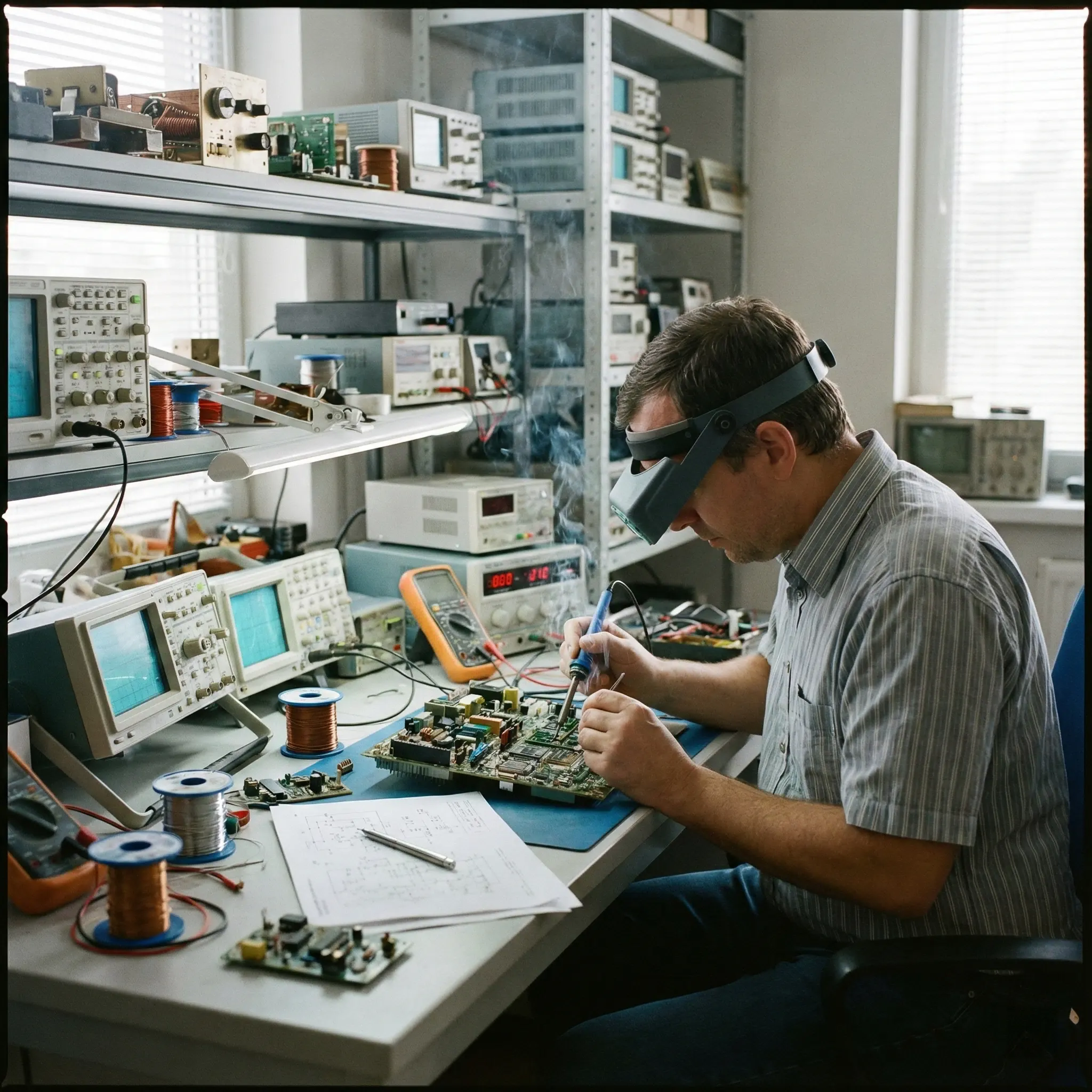
Electricity is the blood of modern civilization. The electrical engineering program in Turkish universities teaches you to design, create, and maintain systems that power the world — from power plants to smartphones.
About the Program
Over four years of intensive study, you'll master electronics, power systems, telecommunications, and control systems — a complete arsenal of a modern electrical engineer.
The program perfectly combines theory with practice: you'll work in laboratories from the first year, design real devices, and intern at energy and technology companies.
After graduation, doors open to energy corporations, telecommunications companies, electronics manufacturers, or you can engage in research in renewable energy.
Who is this specialty for?
This specialty is for you if you:
Electronics fascinates you
You understand devices to figure out how they work, interested in circuits and want to create future technologies.
Math and physics are strengths
Enjoy solving complex problems and calculations. Exact sciences are your tool for creating innovative devices.
Attention to detail is superpower
In electrical engineering, calculation errors can have serious consequences. You work precisely and accurately.
Complex challenges motivate
The harder the problem, the more interesting finding the solution. You don't give up until the system works perfectly.
Curriculum
The electrical engineering program is four years of immersion in electricity and electronics, from basic laws to complex systems. You'll master all tools of a modern electrical engineer.
Year 1: Engineering Foundation
- Introduction to Electrical Engineering — industry history, main directions, and modern challenges
- Mathematical Analysis — advanced mathematics for circuit and system calculations
- Physics for Engineers — electromagnetism, optics, and other physics sections
- Electrical Circuit Analysis — designing circuits from simple resistors to complex filters
Years 2-3: Deep Dive into Specialty
- Electromagnetism — theory of electromagnetic fields and waves, basis of telecommunications
- Digital Electronics — logic circuits, microprocessors, FPGA programming
- Electrical Machines — motors, generators, and transformers
- Power Systems — generation, transmission, and distribution of electricity
- Control Systems — automation of industrial processes
- Telecommunications — principles of communication and data transmission
Year 4: Specialization
- Renewable Energy — solar and wind energy
- Robotics — designing robot control systems
- IoT and Embedded Systems — internet of things and microcontrollers
- Internship — work in energy and technology companies
- Diploma Project — creating an engineering device or system
Career Prospects
An electrical engineering diploma from a Turkish university opens doors to one of the most in-demand and stable professions. As long as electricity exists, there will be people who work with it.
- Electrical Engineer — designing production and distribution systems, $70,000–120,000 per year
- Electronics Engineer — developing and testing electronic devices, $65,000–110,000 per year
- Telecommunications Engineer — designing mobile networks and optical fiber, $60,000–105,000 per year
- Control Systems Engineer — automating factories and smart buildings, $65,000–115,000 per year
- Renewable Energy Engineer — solar and wind power plants, $70,000–120,000 per year
Interesting Fact
Nikola Tesla, one of the greatest engineers in history, conducted experiments at Colorado-Springs where he created artificial lightning with discharges of millions of volts. His work laid the foundation for modern AC power distribution systems.
The battle between Tesla and Edison over AC vs DC power standards shaped electrical engineering for decades. Today, the industry is undergoing a new revolution: renewable energy, electromobility, smart grids, and IoT open unprecedented possibilities.
Student Life
Student life in electrical engineering faculty is immersion in innovation, where theory meets practice at every step.
- Engineering Competitions — robotics and electronic device design competitions
- Hackathons — team solution of engineering tasks in limited time
- Networking — conferences, exhibitions, and masterclasses from leading engineers
- Engineering Society — idea exchange, joint projects, and pet-projects
- Internships — work in energy corporations and tech startups