Turkey is among the world's top ten countries by the number of international students. More than 250,000 people from all over the planet study here today — and the number keeps growing. The best universities in Turkey for international students offer English-taught programmes, international accreditation and direct partnerships with universities in Europe and the United States. This article will help you work out which university is right for you — state or private.
Why Turkey attracts more than 250,000 international students every year
There are several reasons, and they are interconnected. First, Turkey takes part in the Bologna Process: degrees from accredited universities are recognised in the European Union and in most countries in the world. Second, the country is actively developing academic exchange through the Erasmus+ programme and bilateral agreements with universities in the United States, the United Kingdom, Germany and other countries. Third, the cost of tuition and living here is significantly lower than in Western Europe while the quality of education is comparable.
Turkish law splits universities into two categories: state and foundation (private). Each type has its own strengths and its own logic for an international applicant. Let us look at each of them in more detail.
Turkish state universities: strong research, high competition
Turkish state universities are funded from the budget, have a developed research base and a strong academic reputation. Their main advantage is low tuition. The downside for foreigners is that most programmes are taught in Turkish, which creates an additional barrier.
Among the best state universities open to international students:
- Boğaziçi Üniversitesi (Istanbul) — one of the country's leading universities, in the QS top 500. Most programmes are taught in English. Admission is highly competitive.
- Orta Doğu Teknik Üniversitesi — ODTÜ (Ankara) — Turkey's largest technical university, in the QS top 500 for engineering. A strong research tradition.
- İstanbul Teknik Üniversitesi (Istanbul) — a technical university with over 200 years of history. Strong programmes in engineering and architecture.
- İstanbul Üniversitesi (Istanbul) — one of the oldest universities in the country, with a broad range of specialisations.
State universities suit those who know Turkish or are ready to spend a year learning it, want to focus on research and plan to build a career in Turkey. Admission often requires the YÖS exam — a special entrance test for international applicants.
Private universities: international accreditation and a career abroad
Turkey's private (foundation) universities are not run for profit — their founders are usually large family foundations or industrial groups. They reinvest revenue into infrastructure, faculty and international partnerships. That is why private universities are more attractive to those who plan an international career or further studies in Europe or the United States.
Key advantages of private universities for an international student:
- Most programmes are taught in English
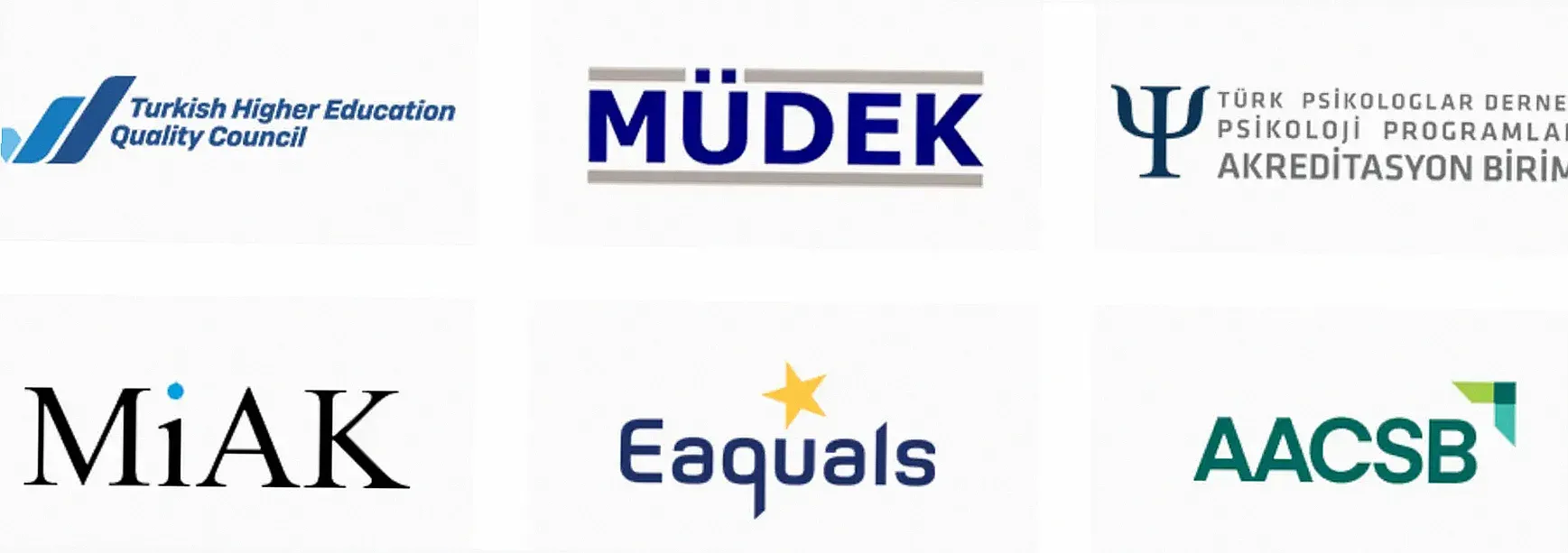
- International accreditation (AACSB for business, MÜDEK for engineering, EAQUALS for language programmes and others)
- Close partnerships with employers — internships and networking during your studies
- More flexible admission conditions: no strict entrance exams
- Participation in academic exchange programmes, including Erasmus+
When choosing a private university, the first thing to look at is the list of accreditations: AACSB, AABInternational, EAQUALS, ACHPA, MÜDEK — these quality marks guarantee that the degree will be recognised abroad.
Top 8 private universities in Turkey for international students
1. Koç University (Istanbul)
In the QS top 500, holds AACSB accreditation. Strong programmes in business, medicine, law and engineering. Teaching in English. Highly competitive admission — but this is where a degree opens the doors to Ivy League master's programmes.
2. Sabancı University (Istanbul)
One of Turkey's strongest research universities. In the QS top 500. The focus is on engineering and natural sciences, with a strong MBA programme. Most programmes are in English.
3. Özyeğin University (Istanbul)
A young and dynamic university with an international faculty team. Has its own internal TRACE test — an alternative to TOEFL, which simplifies admission. Partnerships with companies around the world give students access to internships.
4. Bahçeşehir University — BAU (Istanbul)
A large network of campuses in Turkey and abroad. A wide range of fields: from IT and design to business and law. Well-developed infrastructure for international students.
5. Medipol University (Istanbul)
Specialises in medical and natural-science fields. Has its own clinical bases. One of the few private universities in the country with an internationally recognised medical faculty.
6. Atlas University (Istanbul)
A young university with a medical faculty and an active international policy. Affordable admission conditions, teaching in English.
7. Bilkent University (Ankara)
One of the pioneers of private higher education in Turkey. AACSB accreditation, strong programmes in computer science, economics and humanities. Teaching is mostly in English.
8. Işık University (Istanbul)
A university with solid offerings in engineering and IT. A comfortable campus, moderate tuition and flexible admission requirements for international students.
A complete up-to-date list of universities with programme descriptions, tuition fees and admission conditions is available in our catalogue of Turkish universities.
How to choose between a state and a private university
The answer depends on your goals after graduation.
If you plan to stay in Turkey and build a career here, a state university with a strong local reputation (Boğaziçi, ODTÜ) will be an excellent choice. The main condition is a solid command of Turkish.
If you want to work or study further abroad, choose a private university with international accreditation. A degree from Koç, Sabancı or Özyeğin is better received by foreign employers and foreign master's admissions committees.
If your budget is limited, state universities offer significantly lower tuition for international students. Private universities are more expensive, but often offer discounts for a high school GPA.
For what students really think about life at Turkish universities, read Edu Turkish student reviews. And if you would like to know more about how we help with choosing a university and the admission process, see the about the company section.